Wednesday, March 20, 2013

Today I Realized the Real Role of the Catholic Church in Today's World

Last night I was reading The Power of Myth, and when I got up this morning something hit me.  It was as if all the years of doubt and spiritual quest off the path suddenly revealed to me the purpose and relevance of the Catholic Church in the modern world.  Here is the passage in question: 

CAMPBELL: ... Ortega y Gasset talks about the environment and the hero in his Meditations on Don Quixote.  Don Quixote was the last hero of the Middle Ages.  He rode out to encounter giants, but instead of giants, his environment produced windmills.  Ortega points out that the story takes place about the time that a mechanistic interpretation of the world came in, so that the environment was no longer spiritually responsive to the hero.  The hero is today running up against a hard world that is in no way responsive to his spiritual need.  
MOYERS:  A windmill.  
CAMPBELL:  Yes, but Quixote saved the adventure for himself by inventing a magician who had just transformed the giants he had gone forth to encounter into windmills.  You can do that, too, if you have a poetic imagination.  Earlier, though, it was not a mechanistic world in which the hero moved but a world alive and responsive to his spiritual readiness.  Now it has become to such an extent a sheerly mechanistic world, as interpreted through our physical sciences, Marxist sociology, and behaviorist psychology, that we're nothing but a predictable pattern of wires responding to stimuli. This nineteenth-century interpretation has squeezed the freedom of the human will out of modern life.
(Joseph Campbell with Bill Moyers, The Power of Myth, Chapter 5 "The Hero's Adventure") 
So Campbell points out that today's world is one of machines.  The "mechanistic world," as Campbell calls it, is the world of George Orwell and Aldous Huxley, in which man is reduced to an empty shell perfoming various functions, having no real meaning and no great destiny, perhaps too forgetful or lackadaisical to yearn for more.  The problem that the physical sciences, Marxist sociology, and behaviorist psychology pose for us is a world that is thoroughly dehumanized.  Biology and chemistry may reduce man to a set of processes.  Marxism reduces the individual to a cog in a machine.  And behaviorism reduces man's psyche to a set of conditioned responses that can be controlled or elicited like those of Pavlov's dog.  The whole problem of the Twentieth Century is one of dehumanization. 
In the Twentieth Century, everything began to be done en masse:  mass production (Ford), mass enlistment (World War I), mass media (radio and later television), and even mass murder (the Holocaust).  Where is the individual in all this?  Where is the name to go with the person who gets a number tattooed on his arm in a concentration camp?  Each of the 6 million Jews killed in Europe during the Holocaust had a name and a family and was something more than what the Nazis called him.  So was each of the 20 million killed in the purges of Stalin.  However, the increase in the human population did not bring with it (yet) an increase in the awareness of the value of the human life. 

Perhaps the value of Nietzsche lies in his assertion of the human will.  In the face of the sciences', Marxism's, and behaviorist psychology's reduction of man to various sets of processes, the only proper response is for a man to say, "No!  I am not merely a set of physical and chemical processes, societal functions, or conditioned responses.  I am a person with a name and a history and a purpose.  I have value, and I am going to achieve something."  The individual will is what rescues man from this reduction and dehumanization. 

With this in mind, here is the realization that I had this morning: 

The Catholic Church opposes all these things already.  The Catholic Church opposes modernism and Marxism, and we may see that this opposition may not be based on exclusively theological grounds.  Marxism is not only atheistic, it is a system that oppresses man. 

Furthermore, the Catholic Church decries relativism, asserting that man must absolutely live for something. 

To give another example:  the Church's opposition to same-sex marriage (as far as I can yet discover) is not based only on its teachings regarding sex (which, the Church views, should be unitive and procreative).  Various writings and remarks of Popes John Paul II, Benedict XVI, and Francis on the issue show that these religious leaders have grave concerns that same-sex marriage is a new attempt by the State to usurp the humanity of man, as the State once attempted to do under Communism.  The Church's deep fears on this issue are that same-sex marriage may be the State's means of interfering in the individual's well-being, by tempting him with yet another system.  I, on the other hand, generally think the opposite:  that same-sex marriage would be potentially validating for the individuals who choose to marry so.  However, the Church fears the establishment of a pseudo-family, and for this reason opposes same-sex marriage, almost as it opposes Orwellianism. 

However, as the great conserver of traditions, the Catholic Church was once a system of its own.  It was once the Church that held absolute power in the West, during the Middle Ages and the Renaissance.  Many today perceive the Church for this reason as a power to hold man back in the Dark Ages.  This is how Dan Brown portrays the Church in Angels and Demons and The DaVinci Code.  The modern world has replaced Catholicism and Christianity with other systems such as those noted above, namely the physical sciences, Marxism, behaviorist psychology. 

As I see it, the Catholic Church can have two potential functions.  On the one hand, it can represent the traditional system of morals which the mechanized modern world opposes and with which modern man has broken.  However, the Church can also strenthen its role as the defender of man's humanity.  The Church has the power to focus on the mythological function of religion.  It has the power to remind man of his true human nature and call man toward the inner life.  The Catholic Church can, as indeed all churches and religions can, remind man that he "does not live by bread alone."  One minister I once met told me that he uses The Lord of the Rings (the film) to talk about spiritual birth with his youth group:  "Put aside the Ranger, and become who you were born to be."  It is this spiritual life that Joseph Campbell is talking about.  And it is a life that is open to each of us.  It may not be a life that any system, either modern or traditional, can awaken.  But the Catholic Church has within its arsenal the tools of the spiritual, inner life.  And those are the tools that the Church should develop and implement further. 

Sunday, March 10, 2013

Nietzsche: A Response to G. K. Chesterton

I haven't posted anything here in a long time, but The Catholic Science Geek sent a quote by G. K. Chesterton, the Catholic Englishman, regarding Friedrich Nietzsche, and asked for my opinion. I posted my thoughts on Facebook, but for reference, here they are.  (Shout out to The Catholic Science Geek.)

"THIS, incidentally, is almost the whole weakness of Nietzsche, whom some are representing as a bold and strong thinker. No one will deny that he was a poetical and suggestive thinker; but he was quite the reverse of strong. He was not at all bold. He never put his own meaning before himself in bald abstract words: as did Aristotle and Calvin, and even Karl Marx, the hard, fearless men of thought. Nietzsche always escaped a question by a physical metaphor, like a cheery minor poet. He said, "beyond good and evil," because he had not the courage to say, "more good than good and evil," or, "more evil than good and evil." Had he faced his thought without metaphors, he would have seen that it was nonsense. So, when he describes his hero, he does not dare to say, "the purer man," or "the happier man," or "the sadder man," for all these are ideas; and ideas are alarming. He says "the upper man," or "over man," a physical metaphor from acrobats or alpine climbers. Nietzsche is truly a very timid thinker. He does not really know in the least what sort of man he wants evolution to produce. And if he does not know, certainly the ordinary evolutionists, who talk about things being "higher," do not know either."

~G.K. Chesterton, 'Orthodoxy.'


I will attempt to address these points in order. If Facebook will allow me to hit enter and put them in paragraph form.

1) "No one will deny that he was a poetical and suggestive thinker." This is true. Nietzsche used metaphors to varying degrees throughout his works and almost exclusively in Thus Spoke Zarathustra. This is why it is necessary to read 5-6 of his major works to get any sense out of any of them: they only make sense when you know what ideas his metaphors are referencing. Nietzsche's works fit together like a puzzle: no piece standing alone can reveal the whole picture.

2) "He was not at all bold. ... Nietzsche always escaped a question by a physical metaphor." Yes, that's true of his presentation. He never comes out and says, to borrow from a favorite film of mine, "Zorba, come; or Zorba, don't come." Which is, in turn, my own metaphorical way of saying, "Nietzsche never says plainly what he means." Walter Kaufmann explains in the commentary to his translations of the philosopher that besides being couched in metaphor, everything in Nietzsche is veiled, qualified, and superqualified. Oftentimes, he will use words in a context so that they mean generally the opposite of what they normally mean. He will also make contradictory statements in different passages of his writing, seeming to praise in one place, while seeming to "rip a new one" in other places. Again, only by reading multiple works can one get some sense of what Nietzsche is getting at. I'd say that is the opposite of "clear and bold" in any sense of those words.

3) " 'More good than good and evil,' or 'more evil than good and evil.' " This is probably the Ubermensch concept in a clearer nutshell than Nietzsche gave in the 5 and a half works of his that I've read. An Ubermensch may be higher, but not necessarily better, and not necessarily worse, either. In The Antichrist, Nietzsche writes, "When the exceptional human being treats the mediocre more tenderly than himself and his peers, this is not mere courtesy of the heart--it is simply his duty." This courtesy was something that Nietzsche himself showed in his own dealings with those around him. The implication is that a code of morals "higher" than those currently developed or widely accepted comes with noblesse oblige. I read somewhere once (probably Wikipedia) that in Star Trek: The Wrath of Khan, the generosity and magnanimity of Spock's self-sacrifice come close to Nietzsche's idea of the Ubermensch, in contradistinction to the physical eugenics and despicable acts on the part of Khan: one is only physically developed, while the other is morally developed.

4) "He does not really know in the least what sort of man he wants evolution to produce."

To borrow a passage in Nietzsche's own words (Ecce Homo, "Why I Write Such Good Books," Section 1): "The word 'overman,' as the designation of a type of supreme achievement, as opposed to 'modern' men, to 'good' men, to Christians and other nihilists--a word that in the mouth of a Zarathustra, the annihilator of morality, becomes a very pensive word--has been understood almost everywhere with the utmost innocence in the sense of those very values whose opposite Zarathustra was meant to represent--that is, as an 'idealistic' type of a higher kind of man, half 'saint,' half 'genius.' Other scholarly oxen have suspected me of Darwinism on that account."

To counter Chesterton's idea that Nietzsche "wants evolution to produce [a sort of man]," here Nietzsche writes that the Ubermensch idea does not have to do with Darwinism or evolution. Does Nietzsche ever come out and say what his idea of the Ubermensch really is? Not in the 5 works of histhat I've read. Does Nietzsche himself have an idea in mind? I do not know. However, from what I can gather, the Ubermensch is closer to the idea of an "aristocrat," which ties in with the noblesse oblige mentioned in my previous post.


To conclude, I would say that Nietzsche was in some ways more of a prophet than a thinker, as Chesterton calls him. He was an outspoken critic of the anti-Semitism and German nationalism that he saw accrete around the person of Wagner, and that snowballed throughout the late 19th and early 20th centuries, culminating in the regime of the Nazis. He posed the question of power vs. morality for our own time. In identifying nihilism as the main sickness with which modern man is afflicted, he foresaw what so many traditionalists today describe as the "moral decay" into which the 20th century tumbled further and further.

He also prescribed a sort of remedy to this nihilism: "You call yourself free? Your dominant thought would I hear, and not that you have escaped from a yoke. Are you one of those who had the right to escape from a yoke? There are some who threw away their last value when they threw away their servitude. Free from what? As if that mattered to Zarathustra! But your eyes should tell me brightly: free for what?" The key is to live FOR something, and not to rebel if you cannot handle that responsibility.

I think Nietzsche was light years (or at least decades) ahead of his time. He provides a valuable lens through which to understand the 20th century and the continuing developments in our own society and culture. If you can only get through his metaphors, contradictions, and rants, he actually has something worth hearing.

Thursday, January 17, 2013

A Wonderful Evening

Well, after a three to four month hiatus, I have returned. These four months have been filled with activity, mostly of a studious nature. However, I have had an opportunity to socialize, and I have had some rich experiences.

This weekend I went to an eatery in Princeton with a new friend of mine who is Chinese. We went to a Chinese restaurant, perhaps not very ironically since I love Asian cuisine. We had a good time.

This was my first time having Chinese steamed buns. I ordered the pork buns, and my friend ordered buns containing a pork-crab mix. I also ordered a mango bubble tea, which was tasty, if a little warm. I already knew what I wanted before I came in, but my friend and I waited to order because we were enjoying ourselves looking at the menus, comparing the Chinese characters of the names of the dishes. 

The restaurant had beautiful decorations, booths, place settings, and woodwork. There was a large paragraph in Chinese written on one of the walls. My friend told me the paragraph was a series of compliments to the restaurant. I wish I knew Chinese! The waiters were speaking in a dialect which my Mandarin-speaking friend did not quite make sense of. As we were talking, there was an HDTV set on the wall opposite from us. CNN was showing maps of the nationwide flu epidemic and footage of President Obama and President Hamid Karzai discussing the future of the US's military involvement in Afghanistan. I wish now I had taken pictures--I even had my camera with me, but my friend and I were having so much fun that pictures did not matter to me.

Steamed buns in a bamboo steaming box. (Photograph from Global Bhasin.)

The buns arrived in two round bamboo baskets. A Chinese bun is similar to a dumpling. It is a hollow piece of dough containing a piece of meat and some fatty broth, like a piece wrapping paper rolled up around a baseball. I reached out with my chopsticks, pinched one of the buns at the middle, and dipped it in a small plate of soy sauce and vinegar. As I lifted it to my lips, my chopsticks poked through the doughy membrane, and spilled out all the delicious broth onto my plate. My friend, as a seasoned and native expert at eating these, showed me how to eat them: by gripping the bun by the top with your chopsticks, cradling the bottom in your spoon, then biting through the top and sucking out the broth. I have to admit, this technique was easier, but I still had trouble at it! After a hilarious attempt in which I dropped the bun into the dipping plate and spilled soy-sauce vinegar all over the white table cloth, I decided it would be best if I used a fork.

It was a fun and delicious experience. The pork was so tasty, and the broth even more so. But most of all, I had a delightful evening with my friend. For a few hours, everything else seemed to fade away. I remember the little details and distractions, but the substance of our evening was what made the experience so memorable. What mattered was who we were and where we were, and everything else was incidental. I think I learned something. I hope my friend and I will have many more good times, and I hope you, my reader, will have many good times such as these as well.

Monday, September 17, 2012

An Autumn Message

My dear readers,

First of all, I want to say thank you so much for reading.  As of this week, my blog has been viewed in 19+ countries on five continents!  To all of you reading overseas, thank you.  It is a real thrill to find out that some of my posts about religion and other major topics are at least of some global interest.  To all of you reading here in the US, thank you so much for following.  Most of you are my personal friends, and you've viewed my pages 600+ times in less than a year, and I never expected such a turnout.  Thank you so much for your support. 

Secondly, because you are such loyal readers, I just want to inform you that I will probably be writing less on this blog in the next month or two.  I have a number of essays to write for grad school applications, I have to finish studying for the GMAT, and I've got a number of obligations to fulfill with my family.  I am very passionate when I write posts about religion and other topics, and those have been some of my most viewed posts, which means a lot to me.  However, because writing about religion takes up so much of my energy, for the time being I just need to devote most of that energy to these particular tasks in my life. 

However, I promise not to completely fall off the radar.  I've been working on a few practice translations for this international organization I'm applying to.  Maybe a few of them will find their way onto my blog! 

So once again, thank you all so much for your support.  I'll be sure to keep in touch in the coming weeks. 

The Dionysian Wanderer

(PS. Does anyone out there think I should change that name???) 

Monday, August 20, 2012

Changing Goals

August 20, 2002. Exactly ten years ago tonight, a friend and I went to a theater on Long Beach Island to see one of my favorite musicals, Lerner and Loewe's Camelot. I had read the play in tenth grade English class, and it became an instant favorite. The music was dynamite, and something about the character of Arthur just clicked for me.

However, after reading the play and picturing it, I was severely disappointed by the actual performance at the theater. The curtain rose on a flamboyant knight (in retrospect, I suppose flamboyance could work for a colorful place like T. H. White's Camelot, but it just struck me as being way out of character for the piece). The Merlin was stiff, melodramatic, and sing-songy. I suppose the Guenevere was okay. But the Arthur, my God. From first moment to last, the actor came across as snobby and cynical, which is all wrong for a character who, like Cinderella, was orphaned, raised as a servant to a noble, wealthy family, then pulls a sword from a stone and suddenly becomes "King born of all England." Arthur, in this play, is not cynical; he is boyish to the very end, even when he has lost everything he built and everyone he loved. He is—most of all—idealistic. He wants to create a society where there will be no war or suffering, where people will be governed by law and fairness, and where might does not make right, but where, instead, might is used FOR right. If ever ideals made for a better future, these are they. That is why T. H. White called his book The Once and Future King; these are the ideals for the future—they have to be fought for and worked for. These are the ideals that we as a culture—and I—want to live by.

But the performance of this play wasn't so hot. So when we got home, I turned to my friend and told him that in exactly ten years, I wanted to play King Arthur on stage and do it right. I even wrote down the date and put it in my hardcover Camelot libretto.

This was not the first time I wanted to one up a performer. When I was in middle school, my grandmother and her friends took me to hear Andrea Bocelli sing at the Meadowlands. I was very jealous of the attention these ladies had been paying to Mr. Bocelli of late, and as I wasn't as impressed by his voice as I was by Luciano Pavarotti's, I decided that I could beat Andrea Bocelli at his own musical game. That was when I decided to become an opera singer and travel the world.

That decision was fourteen years ago, and so much has passed since then. I started loading up on opera cd's. I must have learned the music of three or four operas by heart that year. I would close the door to my room and enact the closing scene of Rigoletto, until I gave up that opera for Lent. Little did I know, I couldn't actually sing a note just yet, so I started taking weekly singing lessons from a retired baritone from the Met. I always showed zeal for my interests.

But something about singing (and acting) never quite fit for me. Maybe it was that school work came more naturally for me than music. Maybe it was that I had an easier time learning Italian than I did reproducing and sustaining musical tones. I picked up much Italian vocabulary exclusively from the operas I had memorized and learned the grammar from a Barron's book. Additionally, I was making top grades in my French and Spanish classes at school. And I picked up a few words of Russian from opera and from my aristocratic Russian neighbor, who was like a great-grandmother to me. I loved opera, but I was being pulled (only partly consciously) in another direction.

In college, I continued to pursue language studies, both for class and on my own time. For class, I studied Italian literature, as well as Latin and Ancient Greek. On my own, I learned a few words of Biblical Hebrew as a freshman and then got into Wagnerian opera big time as a junior. Once again, I was learning large chunks of libretto by heart, and this time the German started to make sense using only translations—no dictionaries or grammar books. I also picked up some Icelandic from the Poetic Eddas and some Old English from the epic Beowulf.

Since then, I've been through so much change. My grandmother passed away seven years ago, and I know now how large a role she played in my life, having been a fixture from birth. I lost a cousin in a fatal car accident, and learned for the third time how short life can be. I lost my uncle in the World Trade Center eleven years ago and have seen my large, closely knit extended family torn apart by grief and strife, and known that both sides are in pain because of it. I was once a Catholic, but I stopped going to church a long time ago—when I stopped finding answers to my questions in Sunday sermons—when I started having questions that were not brought up in Sunday sermons. I've questioned God, justice, life, religion, psychology, subjectivity, reality, suffering. In short, the entire foundation on which my life had been built has broken down. My coming of age was distinctly marked by change, both real and symbolic. But I asked questions. And I have found people who could find complex answers to some of those questions. I did not do the traditional thing. I did not go directly from college to work or to grad school. I did go, however, to the works of artists, scholars, filmmakers, and philosophers who had passed that way and had asked the same questions before me. I have found answers, at least a few working answers. I once stood in a pile of rubble. But the cloud of dust has cleared. And like the skinny Englishman and the title character at the end of Zorba the Greek, I laugh!

In the end, the ten year goal I set for myself has not come true. I am not on Broadway or at Lincoln Center singing Camelot or Rigoletto. But I am really happy with the course of my life anyway. I did the Bohemian artsy thing, like any young artist should do. I set out with a career plan, with a variety of plans actually, but I changed when time changed. I haven't tried to force my way headfirst through a wall. I feel at peace. I'm following the Dao, and am in harmony my own nature, which makes me much happier than trying to become an opera singer or a literary scholar. I know more about myself and what to expect from myself than I did ten years ago. Looking back, I think I can see where my natural talent was all along. And I think I have a few ways to go about my goals in life using those talents in particular.

So like Arthur at the beginning of Lerner and Loewe's play, it can't be said that I've achieved my destiny; I've "stumbled upon it." And like Arthur at the end of the play, I haven't let disappointment and destruction break my spirit. I look forward to a future where, in spite of tremendous labor against the darkness, there is hope for the survival of a little bit of light. Impermanence does not deter me anymore. Positive action, whether it has meaning or not, and knowing it, is the solution. It's this that makes life worth living. It's this that gives meaning to the suffering which is everywhere. After many years, Camelot, with its resilience, still means something to me. And that meaning matters more to me than any dream I made for myself years ago.

Friday, August 17, 2012

Culture vs. Civilization

Recently, I read a book by Stephen Prothero called God Is Not One: The Eight Rival Religions That Rule the World and Why Their Differences Matter. I was also speaking with my cousin-in-law Paul, who is English and now an American citizen and resident as well. Paul and Mr. Prothero both made the same observation, one that I found intriguing: that the United States tends to be more religious than Europe. I think this observation is accurate and wondered why that might be, especially at a time when religion is of primary importance to many people in most other part of the world. Europe was also very religious (sometimes violently so) right into the 1600's and 1700's. Where then does this modern European apathy come from? That is going to be the subject of this particular blog post.

Interestingly enough, a sharp decline in Europe's religiosity can be noted around the time of the Age of Reason. This was the era that produced Thomas Jefferson, Isaac Newton, and Wolfgang Amadeus Mozart. This period represented an emphasis on logic in philosophy, objectivity and fair representation in governance, the dominance of form and aesthetic beauty in the arts and architecture, and scientific investigation into the phenomena of the natural world.

However, around the year 1800, significant changes explode into the world. Emotion irrupts into politics and the arts. We see a bloody overturn of the government in the French Revolution, liberal ideals blended with imperial megalomania in the person of Napoleon, whose conquests spread those ideals and inspired democratic revolutions throughout Europe during the following decades, as well as a stormy irruption of emotion into the arts, which produces Beethoven and Wagner in music as well as Lord Byron and later the Gothic style of literature in Germany and Britain. The 1800's saw the monumental unifications of Germany and Italy, as well as struggles for independence, all of them achieved successfully by the year 1919, throughout all of Europe, including Greece, Hungary, Poland, Norway, and among all the peoples of the Balkans. In addition to the revolution in politics and art, new ideas on gender roles and family were sparked, and a French woman wrote books under the masculine pen name of George Sand, wore men's clothes, smoked men's cigars, and lived out of wedlock with her more docile male lover, Frederic Chopin. The 1800's also saw the recognition of the equality of mankind, the abolition of slavery in the United States and of serfdom in Imperial Russia. The century saw the spread not only of democracy but also the birth of a radical new idea of communal property ownership, known as communism. Scholars such as Max Müller began the laborious study of Ancient India and the Far East, and philosophers such as Arthur Schopenhauer and Friedrich Nietzsche introduced Europe to revolutionary Oriental ideas of subjectivity and perspectivism; pioneers such as Sigmund Freud began to explore the depths of the human psyche, while scientists probe the existence and composition of the elements, of genetics, and of the origin of species. During the whole period, we see new and radical ideas in the arts, sciences, politics, and philosophy, and decreasing interest in the Church, even a propensity among some intellectuals to reread Christianity as an early socialist movement (see for example the final pages of Upton Sinclair's The Jungle).

What we see, then, as early as two centuries ago is a breakdown in the traditional values and norms of Europe. This paves the way for the Koyaanisqatsi, the Götterdämmerung, of today—for a civilization out of touch with itself, out of sorts, and spinning ever more wildly like a top losing momentum, ready to fall over and stop turning altogether.

Last week I began reading Sigmund Freud's book Civilization and Its Discontents. An interesting idea, which this book presents, is the idea that culture is a spontaneous byproduct of human creativity. When we write a play that plumbs the depths of the human character, such as Hamlet or Oedipus, that is culture. When we build a cathedral with towering pillars, elaborately carved gateways, gilded ceilings, and beautiful stained glass windows, that is culture. When humans act and create, the result is culture. Art and culture, then, are a reflection of ourselves, the creators. If we look at the art of different periods of a culture, we can learn something about the psyche and values of the people who produced that culture. I would like to explore this idea a little further and examine visually some of the cultural landmarks and developments of our European heritage over the last five to seven centuries. (For those of you who are curious: no, beyond a few short paragraphs, I have not yet read Oswald Spengler's Decline of the West.)


The Early and High Renaissance (1300's-1500's)

Form- The word "form" derives from the Latin word forma, which has two meanings: 1) form and 2) beauty. As an example of this, the Latin word formosa survives today as the Spanish word hermosa, and both words have the same meaning: "beautiful." To the Romans, then, form and beauty were synonymous, and it is this connection between the two of them that drives the rebirth of Classical (Greek and Roman) aesthetic values that is known as the Renaissance. During the high period of the Renaissance, form and idealism were the mandates of art and architecture. Aesthetic beauty and visually pleasing figures were sought and, in fact, created in the arts. In the works of Michelangelo and Raphael, we see the epitome of what man can be: a noble creature full of knowledge and wisdom, aspiring towards greater deeds than have ever been accomplished before. Characteristics of this period are aspiration, political ambition, and a spirit of exploration (two continents previously unknown to Europeans are discovered). The body is beautiful and muscular. Proportion and symmetry reign, be it in architecture or the human body. Objects and persons depicted or sculpted resemble the actual objects and persons: there is idealization, but no abstraction. There is reverence for the sacred. Every inch of a painting, of a sculpture, of a cathedral reveals an artist or a priest or a politician glorying in the talent of man. Diagnosis: in the Europe of this time, man is strong, virile, robust, and healthy.

      Early Renaissance:

Cathedral of Santa Maria di Fiore (Duomo), Florence
http://www.paradoxplace.com/Perspectives/Italian%20Images/images/Firenze/Firenze_Skylines/Florence-Aerial-BR.jpg

Giotto's Mourning of Christ, Scrovegni Chapel (c. 1305)
http://upload.wikimedia.org/wikipedia/commons/4/40/Giotto_-_Scrovegni_-_-36-_-_Lamentation_%28The_Mourning_of_Christ%29.jpg

      High Renaissance:

   Leonardo da Vinci's Mona Lisa (c. 1503–1519) and Vitruvian Man (c. 1497)
File:Mona Lisa, by Leonardo da Vinci, from C2RMF retouched.jpg            File:Da Vinci Vitruve Luc Viatour.jpg


Lorenzo Ghiberti's Story of Joseph, Doors of the Baptistry, Florence (1425)
File:Firenze.Baptistry.door01.JPG

Raphael's School of Athens, from Raphael's Stanze, Vatican Museums (c. 1510)
Click here for a larger image.


Michelangelo's Creation of Adam, Sistine Chapel (c. 1511)
File:Creación de Adán (Miguel Ángel).jpg 
Michelangelo's Last Judgement, Sistine Chapel (1537-1541)
Click here for a larger image.
File:Rome Sistine Chapel 01.jpg


Benvenuto Cellini's Perseus with the Head of Medusa (1545)
File:PerseusSignoriaStatue.jpg


The Baroque Period (1600's)

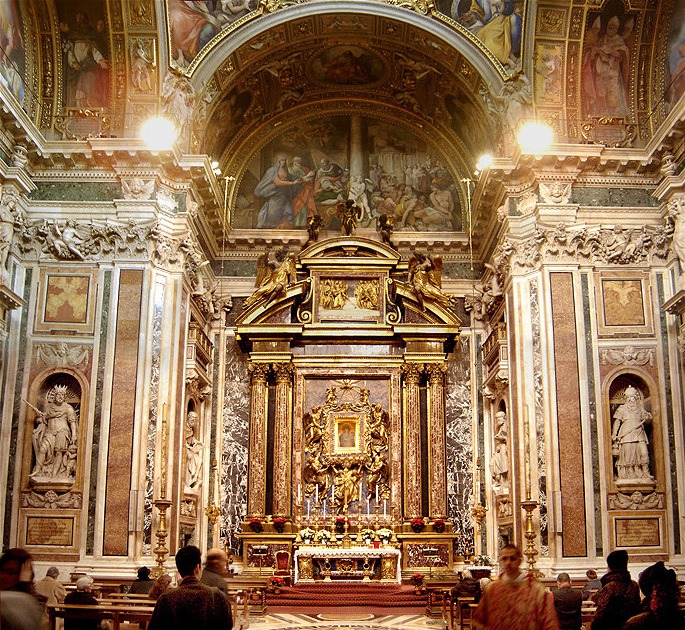
This period is followed by the Baroque period of the 1600's-early 1700's. The Baroque period is typified by extra ornamentation. In architecture, double columns often appear for aesthetic decoration, where only one load-bearer would have sufficed. Enjoyment and mild excess are key to this period; in painting we often see rich gardens and platters of fruits. In painting, chiaroscuro arises: subjects sit in dark backgrounds, lit by a single source of light, which flows over the subjects' contours and casts shadows to the corners. Though highlighting the shadows and lending seriousness to its subjects, the chiaroscuro technique shows a revelry in contemplation.

      Baroque: 

Church of SS. Annunziata, Sulmona

http://upload.wikimedia.org/wikipedia/commons/4/45/Sulmona_15.jpg

Interior of the Church of the Gesù, Rome
File:Lazio Roma Gesu1 tango7174.jpg

Borghese Chapel, Church of Santa Maria Maggiore, Rome File:Santamariamaggiore2b.jpg 
 
Caravaggio's Self-Portrait as Bacchus (1593)
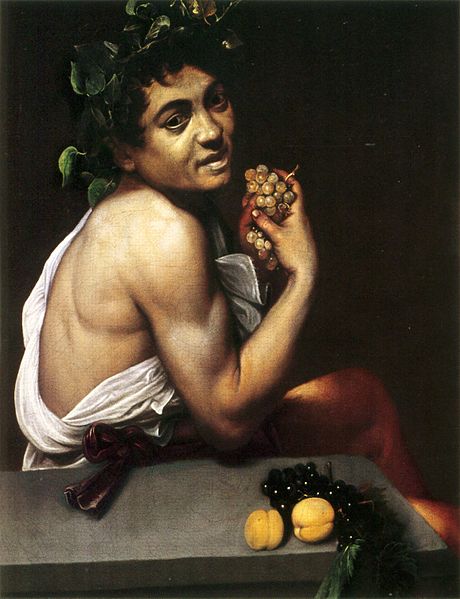
 File:Self-portrait as the Sick Bacchus by Caravaggio.jpg 

       Chiaroscuro:

Georges de la Tour's Penitent Magdalene (c. 1638-1645)
The Penitent Magdalen
 
Caravaggio's St. Francis in Ecstasy (c. 1595)
File:St Francis in Ecstasy.jpg 


The Neoclassical Period (late 1700's-early 1800's)

Following the Baroque comes the Neoclassical Period in art. In philosophy, this is also known as the Age of Reason or Age of Illumination, while in music, it is known simply as the Classical period. The word "Classical" means "like the Ancient Greeks and Romans," and the Neoclassical is the second rebirth of Greco-Roman ideals. During this movement, there is a return to the idealization of the human and of the body that was seen in the Renaissance. Majesty, reason, and zeal are characteristic. Greco-Roman myths are often major subjects. Throughout this style, subjects are still clearly recognizable. Lines are clear, edges of subjects and objects are distinct. Beauty is striven for. The tone is heroic.

      Neo-Classicism:

Jacques Louis David's Death of Socrates
The Death of Socrates - Jacques Louis David - www.jacqueslouisdavid.org

Jacques Louis David's Oath of the Horatii
Oath of the Horatii - Jacques Louis David - www.jacqueslouisdavid.org

Jacques Louis David's Napoleon Crossing the Alps
Napoleon Crossing the Alps - Jacques Louis David - www.jacqueslouisdavid.org

Antonio Canova's Paolina Borghese (Napoleon's sister) as Venus Victrix

Gianlorenzo Bernini's Apollo and Daphne
https://blogger.googleusercontent.com/img/b/R29vZ2xl/AVvXsEif31_mFSfCGYQ4MrrwI90BfQyRYZuYRVNFIQXWQXbRTwrKfqrVZ26KD5oBE9TIGO9MaKVaS25LxxD6ubQuMNhhkKh_u69ZSBNS1HWLJs_Myys7fJKmPxzegFZKNqh9FIPbMLrvTlwzyCpz/s1600/bernini_apollo_and_daphne2.jpg
File:ApolloAndDaphne.JPG


The Romantic Era and Impressionism (1800's)

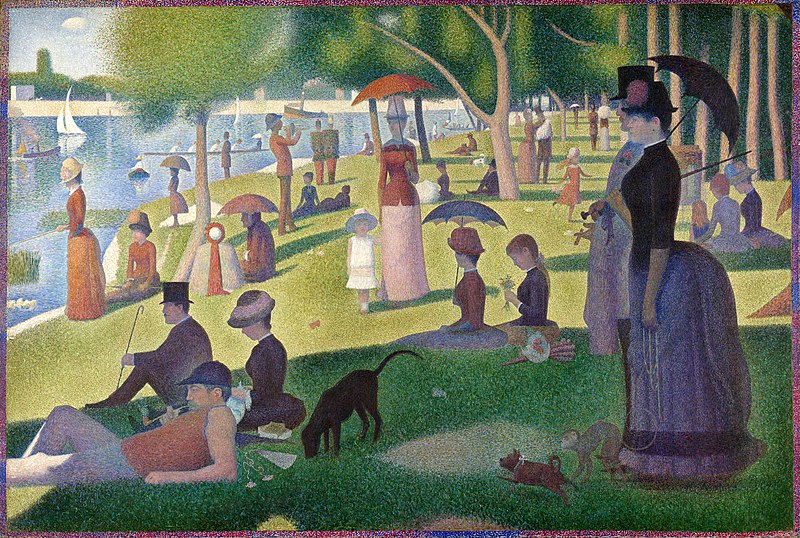
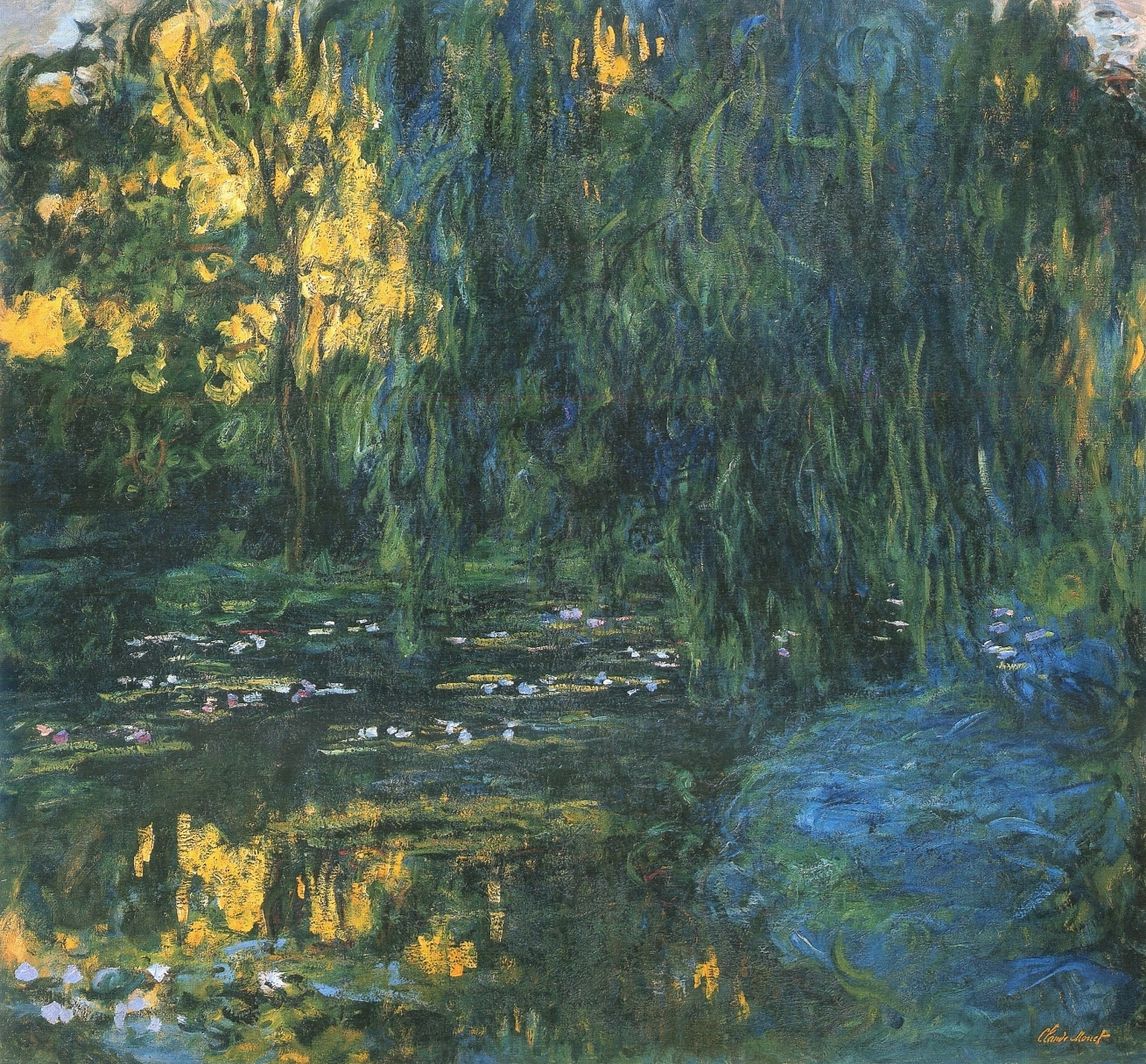
On the other hand, when we look at the art of the Romantic era (early to mid-1800's), we see the beginning of a breakdown in forms. Emphasis is now no longer on form and beauty but on feeling and the sublime. Mood is prevalent. Storm and stress (Sturm und Drang) rage in music. Haunting, gothic images abound, in painting as well as literature (Poe, Brontë, and Mary Shelley flourish in this period). We see more shadows, perhaps even mist. Later, with Impressionism, images and sounds become soft and a little blurry. In painting, we see pointillism, points of dots close enough together to seem to be an image, when viewed from a distance. Emphasis is no longer on distinct edges but on more vague impressions of images. With the Romantic period, form has broken down, and with Impressionism, the fragments of form are beginning to melt as if into jelly.

      Romanticism:

Caspar David Friedrich's Wanderer Above the Mists
The Wanderer above the Mists 1817-18 - Caspar David Friedrich - www.caspardavidfriedrich.org

John Henry Fuseli's The Nightmare
File:John Henry Fuseli - The Nightmare.JPG

      Pointillism and Impressionism: 

Georges Seurat's Sunday Afternoon on the Island of La Grande Jatte (1884)
File:A Sunday on La Grande Jatte, Georges Seurat, 1884.jpg

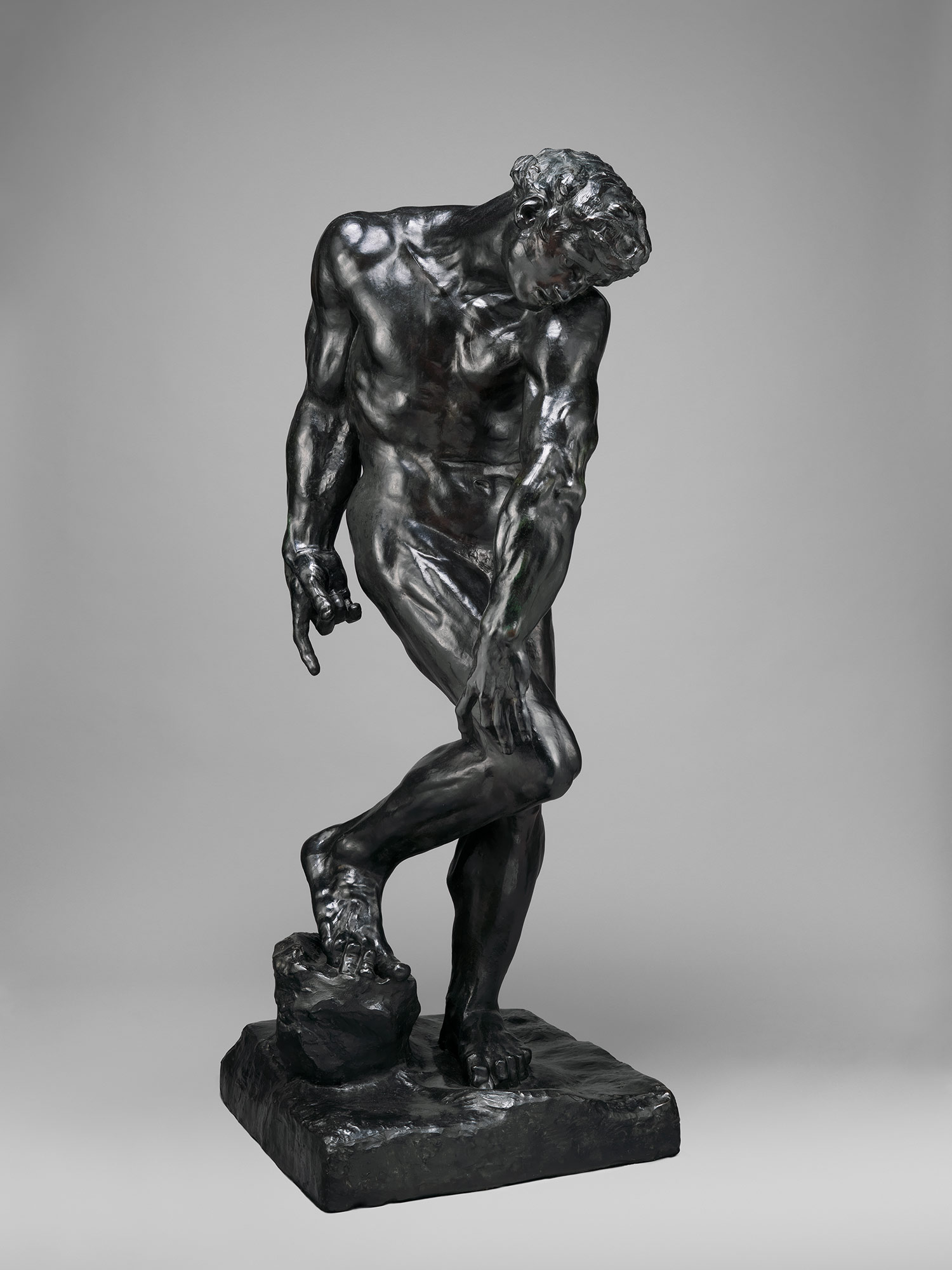
Van Gogh's Self-Portrait (1887)                           Auguste Rodin's Adam (1880) 
File:VanGogh 1887 Selbstbildnis.jpg


Claude Monet's Water Lilies (1907)
File:Claude Monet - Water Lilies.JPG 

Claude Monet's Water Lily Pond and Weeping Willow (1916-1919)
File:Claude Monet, Water-Lily Pond and Weeping Willow.JPG


The Modern Period (1900's)

What we see in the Twentieth Century, then, is the complete breakdown of form in art. We may still like the artwork or dislike it, love it or hate it. But in visible contrast to the earlier Renaissance and Classical periods, emphasis is no longer on idealization, aesthetic beauty, or form. We see images which would traditionally be viewed as chaotic, abstract to the point of being completely unrecognizable, and sometimes what many would call, in grossly subjective terms, ugly. We can also hear this in the dissonance of the music, Igor Stravinsky's Rite of Spring, for example. It is significant that art begins to look ugly right around the time that psychology and psychoanalysis emerge. Art, as a product of our psyche, is a reflection of us as a culture. We begin to see grossness and chaos in the arts as we begin to see these things in ourselves and go to doctors to seek mental treatment.

      Expressionism:

Edvard Munch's The Scream
File:The Scream.jpg

     Futurism:

Umberto Boccioni's Unique Forms of Continuity in Space (1913)
File:'Unique Forms of Continuity in Space', 1913 bronze by Umberto Boccioni.jpg

      Cubism:

              Pablo Picasso's Untitled (1923)                        Pablo Picasso's Portrait of Daniel-Henry Kahnweiler (1910)
Untitled - Pablo Picasso                File:Picasso Portrait of Daniel-Henry Kahnweiler 1910.jpg


       Surrealism:

Salvador Dalí's Persistence of Memory (1931)
File:The Persistence of Memory.jpg

Salvador Dalí's Perseus
File:Dalí.Perseo.JPG

      Abstract Expressionism:

Jackson Pollock's Number 8, 1949

      Architecture:

Guggenheim Museum, New York
File:NYC - Guggenheim Museum.jpg


       The Absurd:

In modern times, nothing is sacred. Sometimes in these advanced stages of decay, we get really silly.

Marcel Duchamp's L.H.O.O.Q.
File:Marcel Duchamp Mona Lisa LHOOQ.jpg
(The French pronunciation of these letters gives us 
the French words:  Elle a chaud au cul,
which means, "She has a hot ass.")

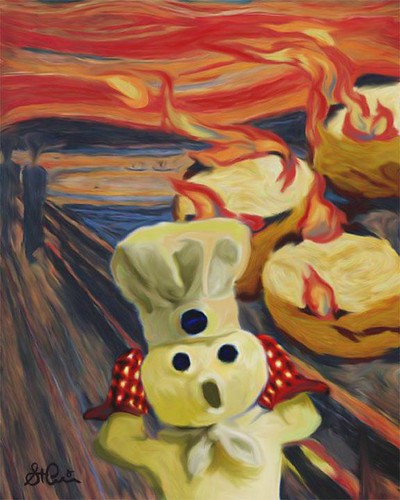
The Pillsbury Dough Boy as The Scream
http://farm4.static.flickr.com/3537/3368792379_4d25493348.jpg
(currently circulating on Facebook)

In the modern period, images of subjects are disordered—look at the odd proportions and positions of body parts in Picasso's work. We see abstraction and surrealism. The general picture is of chaos, madness, or even sickness. (I'm reminded of Fellini's film 8 1/2, where the main character, trapped in his car in a tunnel in a traffic jam, is seized by claustrophobia, rolls down the car window, and climbs out.) The art, and the greater seeking for psychological help, seems to reflect the sorrows of the changes and conflicts of the Twentieth Century: the Russian Revolution, two World Wars, the Holocaust, the atomic bombs. The glorification and idealization of man in the Renaissance and the search for knowledge of the Age of Reason have put the tools of destruction into the hands of the man of Europe, and with them, he has nearly blown himself up. He has not yet, however, reached his end, and that gives cause for hope. If Europe is less religious than America, Europe, having been more directly torn apart by this turmoil, is in a much more skeptical and reflective position than America. Europe is still very much recovering from the two World Wars—spiritually and psychologically. We could view this period as a culture-wide or continent-wide examination of conscience. When Europe emerges, there will be something very different in its values and in its ideals and practices.

I believe it will take a very large, culture-wide effort of planning and soul-searching to set the top aright and set it moving stably once again. It will require a complete revaluation of our history, of our languages, of our culture, and of our beliefs—in other words the tremendous pangs of labor—before we can give birth to a new culture with new values (and probably a new religion). As it stands, our traditional values are not in place—new developments in science and in politics have put us radically out of touch with the Christianity of the Middle Ages. One has only to compare the art of Giotto with the art of Picasso to see this. And a return to such values is simply not possible, given the journey that we have made and the knowledge that we have incorporated along the way.

Thursday, August 2, 2012

Chick-fil-a, Part 2


And people wonder why I am the way that I am.
All this talk of Dan Cathy reminds me of when Princess Margaret of England was in Chicago in the 1970's and remarked that the Irish are pigs. Yes, Princess Margaret, the Queen's sister, called Irish people pigs. Naturally, people all over the US were in an uproar. Well, not that I was alive to see this uproar first hand, but Bill Murray made an awesome comment on it during a "Weekend Update" sketch on Saturday Night Live. It's a classic: 
"Everybody's very upset about it but I say, let her slide on this. I mean, let the woman slide. I know what you're saying, "Bill, you're Irish." I'm a hundred per cent Irish. I'm an American - but the blood is green. ... I say, let her slide. I mean, she was just 'faced, that's all. She was just 'faced. I mean, she hits Chicago, she goes out to dinner with some wild green animals in that town, has a few cocktails and she just gets 'faced, you know. She turns to the Irish mayor of Chicago, Jane Byrne, says the Irish are pigs. Tell me she wasn't too 'faced or nothin'. Not much she wasn't. So let her slide. You know, when somebody gets 'faced, you let 'em slide on that, especially, you know, a girl -- when they get 'faced. And, especially, a member of the royal family, you know?

"Back in England, she's the queen's sister. She can't get weird at all, you know. And, you know, if people don't let you get weird nowadays, you get irreversibly weird, I think. So let her slide! Come on, this is America. Look -- Princess Margaret is a pig. She's a slut, she's a tramp, she's a slime bucket. So what? Right. Exactly. I can say this. She's lettin' me slide. ... You know why? Because this is America. And because I am 'faced. ... I am completely 'faced. I don't know if this is even makin' any sense. Listen, she was 'faced. I am 'faced. So let us both slide on this. God, am I 'faced. ... Jane, are you as 'faced as I am? ... I am completely 'faced."

Sorry I couldn't find the video clip. You can read the full sketch here, including some Roseanne Roseannadanna at the end.


So, in other words, we should let people slide for what they say when they're drunk, right? Riiight. So I'm gonna let Dan Cathy slide for what he said because he was drunk, right? Riiight. Wait, what's that you say? He wasn't drunk? Okay then, in that case, I say screw the man and his fried chicken. I can eat better chicken than that at my mom's kitchen table. And I just did! So I close my words on Dan Cathy with Eddie Murphy's impression of Richard Pryor:  "Tell him I said to have a Coke and a smile and shut the ---- up!"

Bill Murray wants YOU to be a Ghostbuster, not a bigot.
But seriously, the reason this is a problem is because bigotry does not occur alone. Bigotry is equal opportunity. The states that flew Confederate flags and fought for the right to own and whip fellow human beings, the states that enacted Jim Crow laws, are the same states that are fighting most vehemently against the LGBT+ movement. Who else didn't like gay people? Who else didn't like Jewish people and black people? Let me think. Oh yeah, the people in this video:


Did you catch what that duck says at the end of the cartoon, when he hugs the Statue of Liberty? "I'm glad to be a citizen of the United States of America." 


And many people nowadays are attempting to mask their bigotry and hatred with the name of God, the Bible, and tradition. But it is really a mask for ignorance. I am not talking about my friends and other caring religious people. I know that there are so many religious people out there who are struggling with traditional teachings and interpretations but who still want to accept and support their friends and their needs. I know it's not easy to bend the rules, or to learn to look at things from a new perspective, or to be in conflict with what you were taught. I know that from experience. For me, it took a real breakdown and examination of everything I had grown up with. But I have found that it is possible to embrace both the past and the future. It is possible to live within a traditional framework as well as complete your own personal mission in life. And I can testify from personal experience that we are living in a time when, more than ever, it is imperative to breakdown and examine the ideas and traditions we were raised with. It is possible to be faithful to the past and to move forward.

I come from a Catholic background, and I am a first generation American on my mother's side. I grew up with a very close attachment to my Old World grandparents, so close that I have normally always identified more with them and with their traditions than with other Americans. I have studied the Renaissance and the Romantic era as well as the Ancient Greek and Roman eras. I have even lived in Italy for three months. And because our culture is so young, people in this country have almost no idea how old the world really is and how much of the ancient world survives today. It survives in old countries such as Italy, India, and Egypt. The Middle Ages and Enlightenment are also alive today.

All society and civilization is built upon layers, like Constantinople, as is the structure of our psyche. But you also have to define yourself in relation to that psyche, to that civilization, to that system of traditions. You cannot let tradition dictate who you are. Not in the West. You are not living in India and being told to accept and fit the mold into which you were born. You were born in a land with a chance to to define yourself and build your life as you choose. You always carry your tradition and your past with you. But you are another step forward. If you stop and do not take that step forward, your line, your whole family's history, and your own development, stop with you. But if you take that step, you are not leaving behind all tradition. All you have to do is turn around and see the line of the myriad footsteps of your ancestors still in the sand, leading up to where you are now.

Flush that bigotry out with some Colon Blow.